

The Soil Within: Four Hidden Patterns That Keep Powerful Women Disconnected [Staying Human in Hard Times]
What if your survival wasn’t dysfunction—but brilliance in disguise? Especially for Black women who’ve learned to survive by staying small, silent, or strong. But written for every woman who’s tired

Please re-stack it, share it, send this piece to someone you love. The more it travels, the more likely it is to land in the hands—and hearts—of those who need it most.
Because when one of us begins to heal, it sets something powerful in motion.
Healing isn’t just personal. It’s contagious. It’s collective.Thank you for reading.
A Note Before We Begin
Most of my essays end with a regulation toolkit—a set of practices to help bring your body back to safety. But this piece is something different. It’s an opening. A beginning.
What follows is a first glance at four distinct “soil types”—patterns I often see in women who are wise, weary, and wondering why they still feel stuck. You may see yourself reflected in one… or in all of them.
Future essays will dig deeper into each one, offering somatic tools and support for the woman who’s been growing from soil that was never meant to sustain her.
Let this be your first step in gently tending the ground beneath you.
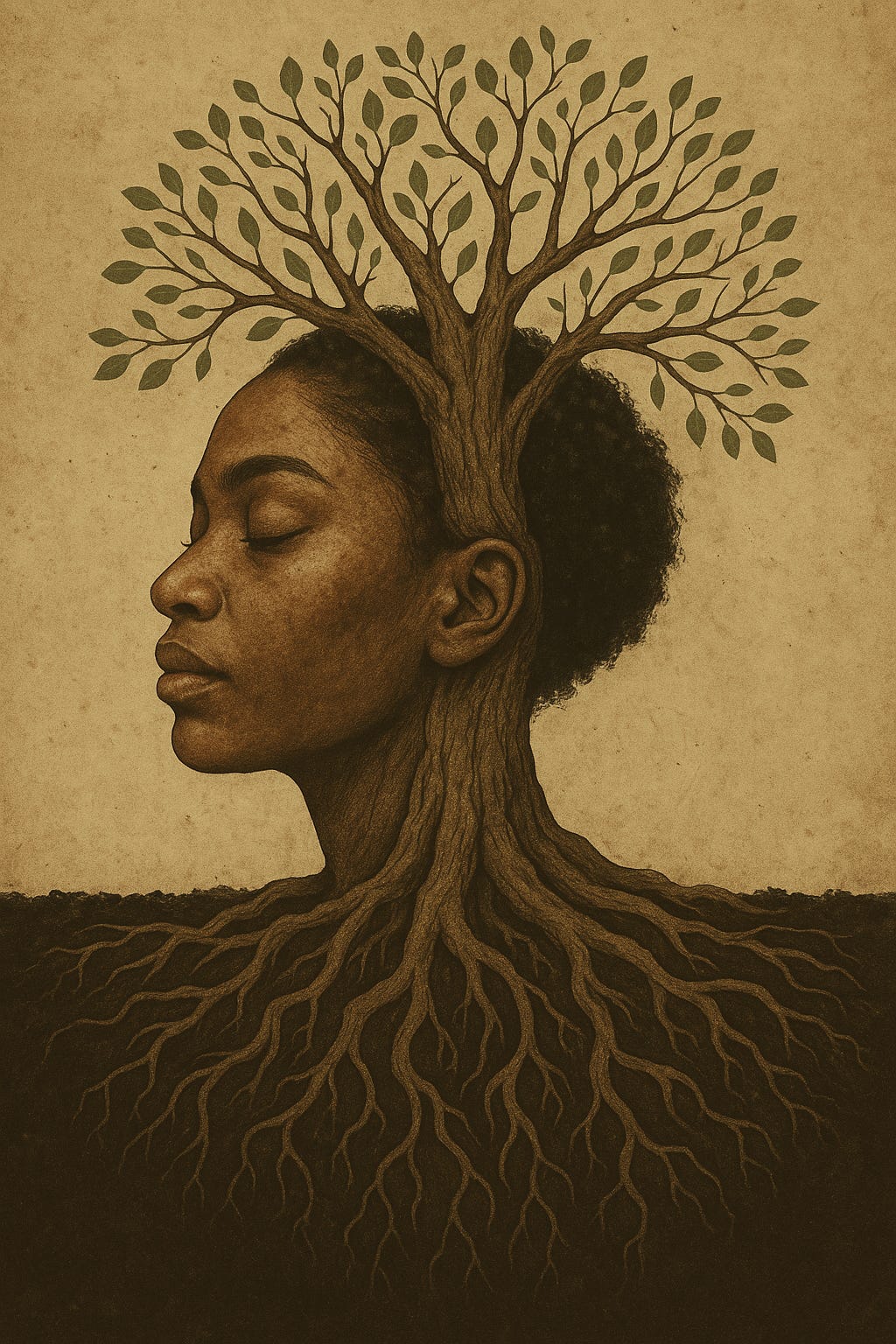
Not all inner soil is the same.
Some of us are parched.
Some of us are packed tight.
Some of us are holding poisons we never asked for.
Some of us are overflowing with insight but still feel unrooted in our bodies.
These aren’t diagnoses. They’re reflections—nervous system patterns I see every day in women who are deeply self-aware, emotionally tired, and quietly unraveling from decades of overfunctioning, people-pleasing, and survival-mode living.
I first introduced this soil metaphor in this earlier essay, when a client asked me, “Do I really have to feel all my emotions?” Her question cracked open a powerful truth: when we’ve lived in survival mode, our nervous systems often bury what was never safe to feel. The soil gets compacted. And yet, we keep trying to plant something new.
If that metaphor speaks to you, I invite you to read that first piece as a companion to this one:
The Soil of a Black Woman’s Body: What Buried Feelings Do to Us [Everyday Regulation]
![The Soil of a Black Woman’s Body: What Buried Feelings Do to Us [Everyday Regulation]](https://substackcdn.com/image/fetch/$s_!_lj_!,w_1300,h_650,c_fill,f_webp,q_auto:good,fl_progressive:steep,g_auto/https%3A%2F%2Fsubstack-post-media.s3.amazonaws.com%2Fpublic%2Fimages%2F252f3a32-d6f4-4bce-ad2e-8bfb8b3a631b_3840x2160.png)
Please like, subscribe, share, and re-stack this piece.
Because you’re not behind. You’re not doing it wrong.
You’re just working with soil shaped by forces you didn’t choose.
The Soil You’re Growing From
Discover the hidden pattern your nervous system has been tending to all along.
1. Dry + Overworked Soil
This is the woman who’s been holding everything up—family, work, schedules, appearances, whole communities. She's productive, dependable, and deeply weary. Even her rest feels like another task to check off.
She doesn’t remember the last time she felt joy without guilt. Or existed without having to prove her worth.
What it feels like:
Burnout. Resentment. A bone-deep tired. Disconnected from yourself, even in your own body.
What your body’s doing:
Running on adrenaline with a quiet undercurrent of collapse. Braced. Tense. Hyperfunctional but empty.
What it needs:
Permission to stop. To say no. To rest without apology.
Practices that whisper: You’ve done enough. You get to come home to yourself now.
Even her rest feels scheduled. She’s productive, but disconnected from herself.
2. Compacted Soil
This is the woman who learned early that there wasn’t room for her emotions. That being soft meant being unsafe. That vulnerability made her a target.
So she learned to perform okay-ness. To keep it moving.
But now, she struggles to feel anything at all. Even when she wants to.
What it feels like:
Numb. Flat. Going through the motions. “I’m fine” on repeat. The tears don’t come. The joy doesn’t either.
What your body’s doing:
Frozen in a slow, steady shutdown. Not because you’re broken—but because you adapted to survive.
What it needs:
Slowness. Co-regulation. Small, steady openings.
Practices that say: You’re allowed to feel. And you don’t have to feel it all at once.
She’s not broken—just frozen. And freezing was smart.
3. Toxic Soil
This is the woman who’s internalized too many stories that were never hers to carry. Maybe she was told she was too much. Or not enough. Or dangerous. Or invisible.
She’s been coded as angry, difficult, ungrateful. She’s spent years shape-shifting to keep people comfortable.
What it feels like:
Over-apologizing. Walking on eggshells. Shame that clings to everything.
What your body’s doing:
Ping-ponging between anxiety and collapse. Fawning to maintain peace.
What it needs:
A slow, sacred detox. Safe witnessing.
Practices that unhook you from inherited lies and help you rebuild your relationship with yourself.
You don’t need to be fixed. You need to be freed.
4. Overfed, Unrooted Soil
This is the woman who knows all the terms—attachment styles, boundaries, somatics, cycles. She’s followed the therapists. Bought the journals. Listened to the podcasts.
And still? She’s stuck.
She’s got insight fatigue. She’s overthinking healing instead of living it.
What it feels like:
“I know better, so why can’t I do better?” Spinning in the mind. Longing for change but anchored in overanalysis.
What your body’s doing:
Oscillating between activation and shutdown. Head full of tools, but body still braced.
What it needs:
Less information. More embodiment.
Practices that help you feel safe, not just understand safety.
You don’t need more input. You need integration.
A Final Word
There is nothing wrong with you.
These aren’t flaws.
They are survival responses—brilliant, intuitive adaptations born from real pain, real systems, real lived experience.
Your soil doesn’t need judgment.
It needs tending.
Compassion.
Nourishment.
A little turning over, breath by breath.
Especially for those of us living in Black bodies, this kind of healing is more than personal.
It’s political. It’s ancestral. It’s protest.
Choosing to rest, to feel, to reclaim joy, to come home to your body—that is resistance.
It’s how we interrupt the legacy of disappearing ourselves for others’ comfort.
It’s how we rewrite the story, starting in our own nervous systems.
You don’t need better seeds.
You need soil that can breathe.
And maybe, as you read this, you recognized yourself in more than one soil type. That’s okay. Most of us carry layers. That just means you’ve been surviving in a world that asked too much of you.
You’re not behind. You’re not broken. And you’re definitely not alone.
I’ve walked beside many women who are gently loosening what’s been compacted and remembering how to root again.
I’d be honored to walk with you, too.
With love and breath,
Alyssa
This is just the beginning.
Each soil type has its own story, its own wisdom, its own path to healing. In future pieces, I’ll guide you through them one by one—with practices to help you reconnect to your body, your boundaries, and your joy.
Subscribe to grow with me.
And if you feel called to share below, I’d love to hear:
What soil type resonates most for you?
And what has helped you tend to it—gently, imperfectly, in your own way?
Written by Alyssa Thompson Tolosa. Thoughtfully edited with ChatGPT. Intentionally curated with deep love and respect.
I am very moved by everything (e-v-e-r-y-t-h-i-n-g) in this article ... and ... these two sentences poked me between the spiritual eyes: "She’s got insight fatigue. She’s overthinking healing instead of living it." WoWoWoWoWoW, Alyssa, you have a knack for writing in word pictures, and I am deeply grateful. You have made a difference in my life today.
I will absolutely read this tomorrow. Thank you for sharing.